
Hydroparasitology Research Group
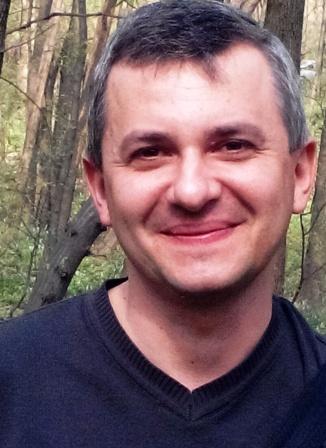
Head of Department
Юришинець Володимир Іванович
докт. біол. наук., ст. наук. співроб.
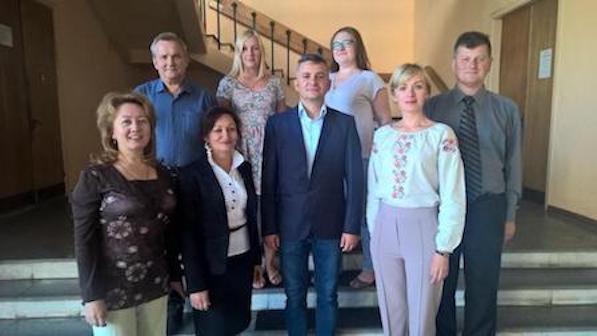
Hydroparasitology Research Group (left to right):
Ларіонова Діана, Воліков Юрій, Копча Неля, Шлапак Ольга, Юришинець Володимир, Єрьоменко Дар'я, Старосила Євгенія, Давидов Олег
пров. наук. співроб., д.б.н., с.н.с.
Юришинець Володимир Іванович
заступник, ст. наук. співроб., к.б.н., с.н.с.
Давидов Олег Анатолійович
ст. наук. співроб., к.б.н., с.н.с.
Воліков Юрій Миколайович
ст. наук. співроб., к.б.н.
Старосила Євгенія Василівна
наук. співроб., к.б.н.
Рибка Тетяна Сергіївна
мол. наук. співроб., к.б.н.
Красуцька Наталія Олександрівна
в.о. мол. наук. співроб.
Ларіонова Діана Павлівна
пров. інж., к.б.н.
Заіченко Наталія Вікторівна
пров. інж.
Копча Неля Миколаївна
пров. інж.
Щербина Ольга Євгенівна
аспірант
Шлапак Ольга
аспірант
Єрьоменко Дар'я
аспірант
Прімачов Михайло
Research Directions
Fundamental Research:
- Investigation of the ecosystem role of symbiotic organisms of aquatic organisms.
- Study of bacterioplankton and bacteriobenthos as the main components of freshwater biocoenoses transforming flows of matter and energy.
- Investigation of symbiocoenotic systems at different levels under conditions of global change in aquatic ecosystems.
- Development of principles and methodology for assessing the state of freshwater ecosystems and water quality based on parasitological and microbiological indicators.
Applied Research:
- Monitoring of surface bathing waters in accordance with Directive 2006/7/EC.
- Research into the parasitological situation of multipurpose water bodies.
- Development of measures to prevent epizootics in commercially valuable aquatic organisms.
- Development of measures to prevent negative phenomena associated with parasitic organisms in the multi-purpose use of water bodies.
Results
A comprehensive approach to assessing the sanitary-hydrobiological state of water bodies in urbanised territories has been proposed, integrating the evaluation of water environment safety based on chemical and sanitary-epidemiological (parasitological) indicators with a modern ecological assessment using the methodology of the EU Water Framework Directive 2000/60.
Conceptual approaches to the eco-physiological interaction between symbionts and the environment — resulting in their phenotypic variability — and between aquatic host organisms with their symbiocoenoses (with defined structural characteristics) and the environment — resulting in changes to the physiological and biochemical characteristics of the aquatic organism — have been formulated for the first time.
It has been established that the destabilising influence on the structure of aquatic organism symbiocoenoses is realised through direct effects on symbionts, causing changes in their abundance and species richness, as well as indirectly through changes in host metabolism and its relationships with symbionts.
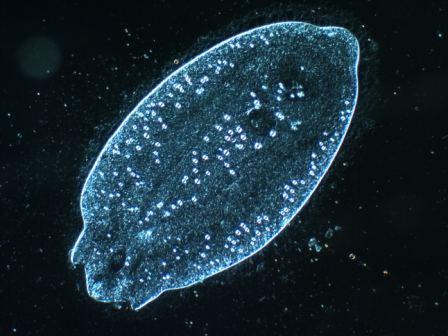
The role of symbionts of native and invasive invertebrate and fish species in freshwater ecosystems of various types has been studied. Invasive symbiont species specific to representatives of different taxonomic groups of molluscs and fish have been identified. A range of native symbiont species that utilise abundant populations of invasive mollusc and fish species to complete their life cycles has been recorded for the first time.
Features of structural-functional rearrangements in symbiocoenoses of aquatic organisms (molluscs and fish) under the influence of temperature increase have been established, and a forecast of changes in the parasitological situation under climate change has been made.
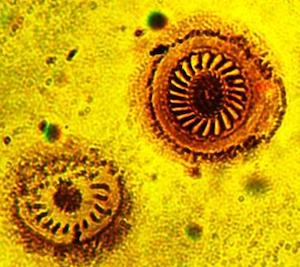
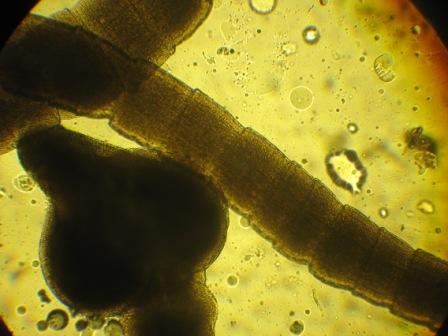
The morphology, ultrastructure, molecular phylogeny, and biotic relationships of unique amoeboid organisms isolated from Mesozoic bentonite clay deposits have been studied.
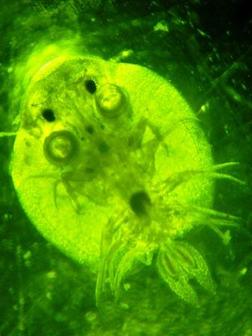
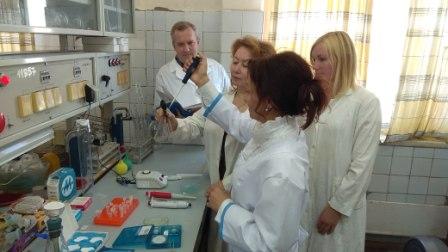
Illustrations
Selected Publications
- Юришинець В.І. Симбіоценози гідробіонтів як компоненти прісноводних екосистем. – К.: Наукова думка, 2013. – 120 с.
- Oleynik G.N., Yurishinets V.I., Starosila Ye.V. Viruses in aquatic ecosystems: distribution and ecological role (a review) // Hydrobiological Journal. – 2012. – Vol. 48, N 5. – P. 69–75.
- Yurishinets V.I., Rybka T.S., Zaichenko N.V. Taxonomic diversity and complexity of zooplankton communities in water bodies of various types // Hydrobiological Journal. – 2015. – Vol. 51. – Issue 1. – P. 36–48.
- Zaichenko N.V. Finding of Gyrodactylus perccotti (Plathelminthes, Gyrodactylidae) in water bodies of Kyiv region // Vestnik zoologii. – 2015. – №49 (2). – P. 181–184.
- Zaichenko N.V. Parasite fauna of Amur sleeper Perccottus glenii Dybowski, 1877 (Osteichthyes: Odontobutidae) in some water bodies of Kyiv oblast // Russian Journal of Biological Invasions. – 2015. – Volume 6, Issue 3. – P. 165–169.
- Yurishinets V.I., Zaichenko N.V. Comparative analysis of the Parasite Fauna of Pseudorasbora parva (Cyprinidae) in the native and non-native areas of its distribution // Hydrobiological Journal. – 2015.
- Romanenko V.D., Yuryshynets V.I., Potrokhov O.S., Zin'kovskiy O.G. Peculiarities of physiological-biochemical interrelations in symbiotic communities of freshwater fishes under the impact of inorganic nitrogen compounds // Hydrobiological Journal. – 2015.
- Krasutskaya N.A., Yurishinets V.I. Effect of trematoda infestation on total protein content and succinate dehydrogenase activity in hepatopancreas of the snail Viviparus viviparus L. under different temperature // Hydrobiological Journal. – 2015.
- Yuryshynets V.I., Korniushyn V.V., Podobaylo A.V. The First Finding of Plerocercoids Ligula pavlovskii Dubinina, 1959 (Cestoda, Diphyllobothriidae) in Gobies from the Freshwater Kakhovka Reservoir // Hydrobiological Journal. – 2017.
- Starosila Ye.V., Oleynik G.N., Golovko T.V., Yuryshynets V.I. Viruses in microbial "loop" in the aquatic ecosystems (a review) // Hydrobiological Journal. – 2012.
- Oksiyuk O.P., Davydov O.A. Sanitary hydrobiology in present period. Main provisions, methodology, tasks // Hydrobiological Journal. – 2013.
- Oksiyuk O.P., Davydov O.A., Karpezo Yu.I. Sanitary and hydrobiological assessment of the state of the river section of the Kanev reservoir in terms of the structural indices of microphytobenthos algae cenoses // Hydrobiological Journal. – 2012.
- Karpova G.A., Klepets Ye.V. Influence of urban landscapes on the structural indices of macrophytes in the Vorskla River // Hydrobiological Journal. – 2014.
- Karpova G.A. Phytomass of the reed (Phragmites australis) as indicator of the trophic status of the water bodies // Hydrobiological Journal. – 2014.